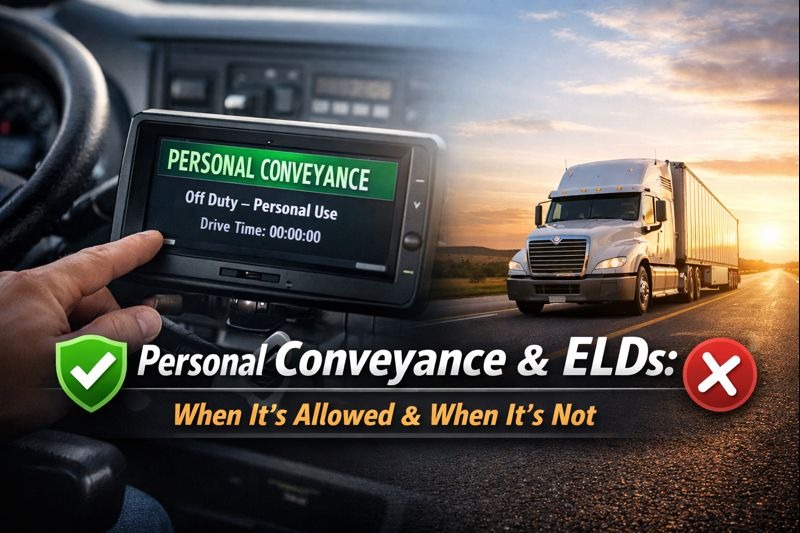
Electronic Logging Devices (ELDs) have transformed how commercial drivers track Hours of Service (HOS). One of the most misunderstood areas within ELD compliance is personal conveyance (PC)—specifically, when it is allowed, how it should be recorded, and when it crosses the line into a violation.
This guide breaks down personal conveyance ELD rules, explains FMCSA guidance, and gives real-world examples so drivers, fleet managers, and safety teams can stay compliant while using off-duty driving correctly.
What Is Personal Conveyance?
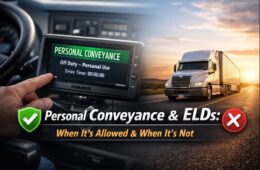
Personal conveyance refers to the movement of a commercial motor vehicle (CMV) for purely personal reasons while the driver is off duty. When used correctly, PC time does not count against a driver’s HOS limits.
Under FMCSA guidance, personal conveyance is:
- Voluntary
- Off duty
- Not advancing the commercial interests of the motor carrier
When logged properly on an ELD, personal conveyance appears as off-duty driving rather than on-duty or driving time.
How Personal Conveyance Works on an ELD
Most ELDs include a Personal Conveyance mode that drivers must manually select. When enabled:
- The vehicle may move while the driver remains in off-duty status
- Mileage is recorded but excluded from HOS calculations
- An annotation or remark is often required (recommended even if not mandatory)
Failing to select PC mode—or using it incorrectly—can result in violations during inspections or audits.
FMCSA Personal Conveyance Rules Explained
The PC rules FMCSA outlines focus on intent and benefit. The key question inspectors ask is:
“Is this movement advancing the motor carrier’s business?”
If the answer is yes, personal conveyance is not allowed.
Allowed Uses of Personal Conveyance
Personal conveyance is allowed when:
- Driving from a terminal or shipper to a hotel or restaurant after being relieved from duty
- Traveling from home to a personal destination (shopping, meals, entertainment)
- Moving a CMV for personal safety reasons (e.g., unsafe parking area)
- Returning to a terminal after being released from duty (without further dispatch)
Not Allowed Uses of Personal Conveyance
Personal conveyance is not allowed when:
- Driving toward the next load or shipper
- Moving a truck to meet a dispatch or reduce future on-duty driving
- Transporting cargo (loaded or empty) for business purposes
- Repositioning a vehicle at the carrier’s request
If the movement benefits the carrier—even indirectly—it must be logged as on-duty driving.
Common Personal Conveyance ELD Mistakes
Many violations stem from misunderstanding rather than intentional misuse. Common errors include:
- Using PC to drive closer to the next pickup
- Forgetting to switch back to on-duty status
- Using PC while under dispatch
- Not documenting the reason for PC use
Safety departments should train drivers to annotate PC events clearly to avoid confusion during roadside inspections.
Personal Conveyance vs Yard Moves
Personal conveyance is often confused with yard moves, but they are very different:
| Feature | Personal Conveyance | Yard Moves |
|---|---|---|
| Duty Status | Off duty | On duty (not driving) |
| Purpose | Personal | Work-related |
| HOS Impact | No | Yes |
| Location | Public roads allowed | Restricted to yards/terminals |
Using the wrong status can trigger HOS violations.
Best Practices for Staying Compliant
To stay compliant with personal conveyance ELD rules:
- Use PC sparingly and only when clearly personal
- Always annotate why PC was used
- Never use PC while dispatched or carrying out work instructions
- Train drivers on FMCSA intent-based enforcement
- Review PC usage during internal audits
Clear policies and consistent training reduce violations and CSA risk.
Why Personal Conveyance Matters
Proper use of personal conveyance protects drivers from unnecessary HOS violations while ensuring fleets remain compliant. Misuse, however, can:
- Lead to log falsification citations
- Increase CSA scores
- Trigger audits or enforcement action
Understanding when ELDs allow personal conveyance—and when they don’t—is essential for modern fleet compliance.
Conclusion
Personal conveyance is a valuable tool when used correctly, but it comes with strict boundaries. By understanding personal conveyance ELD rules, following PC rules FMCSA, and logging off duty driving accurately, drivers and carriers can stay compliant and inspection-ready.
When in doubt, remember: if the movement benefits the carrier, it’s not personal conveyance.
Frequently Asked Questions (FAQs)
What is personal conveyance on an ELD?
Personal conveyance on an ELD allows a driver to move a commercial vehicle for personal reasons while remaining off duty, as long as the movement does not benefit the carrier.
Does personal conveyance count toward hours of service?
No. When used correctly, personal conveyance is logged as off-duty driving and does not count against HOS limits.
Can I use personal conveyance to drive to my next load?
No. Driving toward a pickup or shipper advances the carrier’s business and must be logged as on-duty driving.
Is personal conveyance allowed while under dispatch?
Generally no. If you are under dispatch or moving at the carrier’s direction, personal conveyance is not permitted.
Do I need to add remarks for personal conveyance?
While not always required, adding remarks is strongly recommended to explain the personal nature of the movement during inspections.
What happens if personal conveyance is misused?
Misuse can result in HOS violations, citations, increased CSA scores, and potential audits.