Many drivers assume that spending time in the sleeper berth automatically pauses the 14-hour driving window. In reality, this misunderstanding is a leading cause of logbook violations. The sleeper berth 14 hour rule is very specific, and when it is misapplied, drivers quickly accumulate hidden Hours of Service (HOS) violations.
This article explains why your sleeper berth break didn’t pause the 14-hour clock, clarifies when sleeper time counts, and outlines how to avoid costly HOS compliance errors.
Understanding the Sleeper Berth 14-Hour Rule
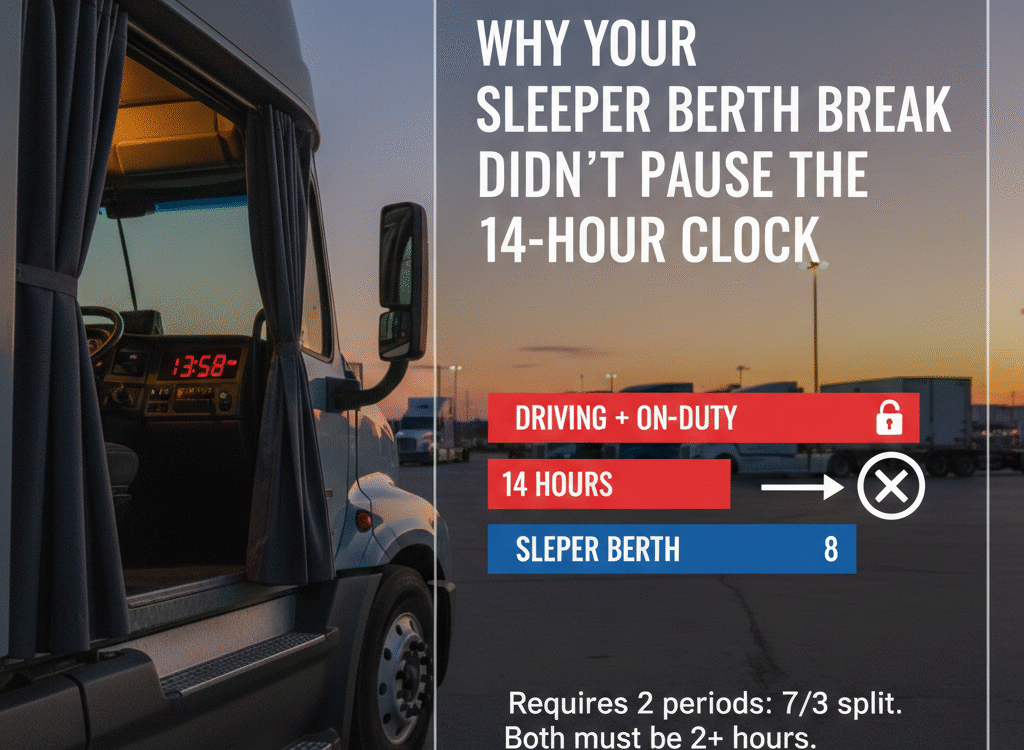
Under FMCSA regulations, not all sleeper berth time pauses the 14-hour clock. Only qualifying sleeper berth periods used as part of a valid split sleeper arrangement can stop the 14-hour window from advancing.
To qualify:
- One rest period must be at least 7 consecutive hours in the sleeper berth
- The second rest period must be at least 2 consecutive hours, taken off-duty or in the sleeper berth
- Both periods together must equal a minimum of 10 hours
If these conditions are not met, sleeper berth time is treated the same as off-duty time and does not pause the 14-hour clock.
Common Reasons Sleeper Time Does Not Pause the 14-Hour Clock
1. The Sleeper Break Was Too Short
A sleeper berth period of less than 7 consecutive hours does not qualify for the split sleeper provision.
Example:
- Taking a 5-hour sleeper berth break mid-shift
While this time provides rest, it does not pause the 14-hour clock. The clock continues to run, often leading drivers to unknowingly exceed available hours.
2. The Break Was Not Paired With a Second Qualifying Period
A sleeper berth break does not work in isolation. Until it is paired with a second qualifying rest period:
- The split sleeper is not active
- The 14-hour clock does not pause
This is a frequent source of confusion and results in retroactive violations once logs are reviewed.
3. The Break Was Logged in the Wrong Duty Status
Incorrect log entries are another major reason sleeper time fails to pause the clock.
Common logging errors include:
- Logging sleeper berth time as off-duty
- Switching duty status during what should be a consecutive sleeper period
Even small interruptions invalidate the sleeper period, causing the system to treat it as standard off-duty time.
4. The Driver Expected a Reset Instead of a Pause
The split sleeper provision does not reset the 14-hour window.
Key distinction:
- A 10-hour off-duty break resets the clock
- A qualifying split sleeper period only pauses the clock
Available driving time is recalculated from the end of the most recent qualifying break, not from the beginning of the shift.
5. Overreliance on ELD Calculations
Many drivers assume their ELD will automatically manage split sleeper calculations correctly.
However:
- Some ELDs allow driving that later calculates as a violation
- Many systems do not clearly explain why sleeper time did not pause the clock
Ultimately, drivers and carriers remain responsible for understanding when sleeper berth time counts and when it does not.
When Sleeper Berth Time Does Pause the 14-Hour Clock
Sleeper berth time pauses the 14-hour clock only when all split sleeper conditions are satisfied.
Valid examples include:
- 7 hours sleeper + 3 hours off-duty
- 8 hours sleeper + 2 hours off-duty or sleeper berth
When used correctly, the clock stops during the qualifying sleeper period and resumes based on the recalculated window.
Best Practices to Avoid 14-Hour Clock Violations
- Do not assume sleeper time automatically pauses the clock
- Use only FMCSA-approved split sleeper combinations
- Confirm both qualifying breaks are completed before extending driving time
- Review duty status entries for accuracy and continuity
- Understand how your ELD displays split sleeper calculations
Consistent log reviews and driver education are essential for preventing violations.
Conclusion
Misunderstanding the sleeper berth 14 hour rule is one of the most common causes of HOS violations. Sleeper berth time only pauses the 14-hour clock when used correctly under the split sleeper provision.
By understanding when sleeper time counts, avoiding logging errors, and monitoring the HOS clock pause rules carefully, drivers and fleets can prevent violations, protect safety scores, and remain inspection-ready.
Frequently Asked Questions (FAQs)
Why didn’t my sleeper berth break stop the 14-hour clock?
Because the break did not meet the split sleeper requirements. Sleeper berth time pauses the 14-hour clock only when used as part of a valid split sleeper arrangement.
Does any sleeper berth time pause the HOS clock?
No. Only qualifying sleeper berth periods under the split sleeper provision pause the 14-hour clock. Short or unpaired sleeper breaks do not.
Is sleeper berth time the same as off-duty time?
Not always. Sleeper berth time has special rules, but if it does not meet split sleeper requirements, it is treated the same as off-duty time for 14-hour calculations.
Can an ELD incorrectly show available driving time?
Yes. ELDs assist with calculations but do not prevent violations. Drivers must verify compliance independently.