
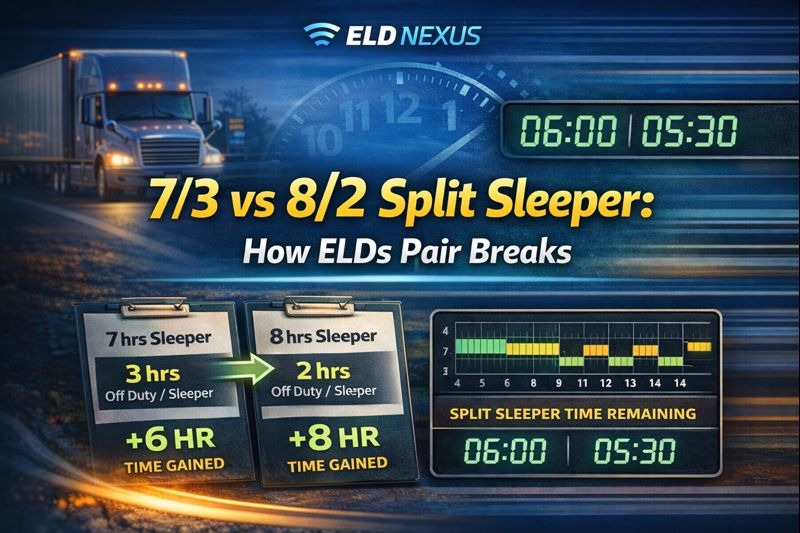
The split sleeper rule becomes even more confusing when drivers hear terms like 7/3 split sleeper and 8/2 split sleeper. Many ask the same question: How does my ELD know which breaks to pair—and why does my available time change afterward?
The answer lies in split sleeper calculation logic built into modern ELDs. In this guide, we’ll break down how 7/3 and 8/2 splits work, how ELDs pair qualifying breaks, and why your available drive time may increase after the second break.
Understanding the Split Sleeper Rule (Quick Recap)
FMCSA allows drivers to split their required 10-hour off-duty period into two qualifying breaks:
- 7 consecutive hours in the sleeper berth + 3 hours off-duty or sleeper
- 8 consecutive hours in the sleeper berth + 2 hours off-duty or sleeper
These splits do not reset the 14-hour clock in the traditional way. Instead, they recalculate it—this is where ELD logic becomes critical.
7/3 Split Sleeper Explained
The 7/3 split sleeper option provides flexibility when drivers can’t commit to a long sleeper break.
How it works:
- Minimum 7 hours in the sleeper berth
- Remaining 3 hours off-duty or sleeper
- Total equals the required 10 hours
Key impact:
- The 7-hour sleeper period pauses the 14-hour clock
- The 3-hour break completes the split
- The ELD recalculates available time based on the end of the first qualifying break
This option is popular with drivers dealing with shipper delays or congested delivery windows.
8/2 Split Sleeper Explained
The 8/2 split sleeper is the most commonly used and easiest to manage.
How it works:
- Minimum 8 hours in the sleeper berth
- Remaining 2 hours off-duty or sleeper
- Total still equals 10 hours
Key impact:
- The 8-hour sleeper break does NOT count against the 14-hour clock
- The shorter 2-hour break completes the pair
- The ELD recalculates your drive and on-duty time
Because the longer sleeper period offers more rest, many fleets prefer the 8/2 option for safety and compliance.
How ELDs Pair Split Sleeper Breaks
This is where most confusion occurs.
ELD pairing logic:
- The ELD scans your log for a qualifying sleeper berth period
- It then looks for a matching shorter break
- Once both are completed, the ELD pairs them
- Available hours are recalculated, not reset
This split sleeper calculation happens automatically. The ELD always pairs the most recent valid combination that gives the driver the greatest legal availability.
Why Your Available Time Changes After the Second Break
When your ELD pairs a 7/3 or 8/2 split:
- The 14-hour clock is recalculated from the end of the first qualifying break
- Time spent resting is removed from the duty window
- You may see more available drive time
This feels like time is being “added,” but it’s actually time that was legally paused.
7/3 vs 8/2: Side-by-Side Comparison
| Feature | 7/3 Split Sleeper | 8/2 Split Sleeper |
|---|---|---|
| Minimum sleeper time | 7 hours | 8 hours |
| Short break | 3 hours | 2 hours |
| Flexibility | Higher | Moderate |
| Rest quality | Moderate | Higher |
| Ease of planning | Moderate | Easier |
| Common usage | Delays, urban runs | Long-haul |
How ELD Nexus Handles Split Sleeper Calculation
Split sleeper math is complex—and manual tracking is risky.
ELD Nexus automatically:
- Detects valid 7/3 and 8/2 combinations
- Pairs breaks correctly in real time
- Recalculates available hours accurately
- Clearly displays remaining drive and duty time
With ELD Nexus, drivers never have to guess which split applies—the system always uses the best legal option.
Common Mistakes with 7/3 and 8/2 Splits
- Sleeper time under 7 hours
This does not qualify and will not pause the clock. - Assuming off-duty equals sleeper berth
Only the longer break must be sleeper berth time. - Mixing splits with a 10-hour reset mid-cycle
This can invalidate the split pairing. - Misreading ELD recalculations
A compliant ELD like ELD Nexus prevents this confusion.
Final Thoughts
Understanding the difference between 7/3 split sleeper and 8/2 split sleeper helps drivers plan smarter and avoid HOS violations. When ELDs pair breaks correctly, it can feel like time is being returned—but it’s simply compliant recalculation.
With ELD Nexus, split sleeper rules work for you—not against you.
Frequently Asked Questions (FAQs)
What’s the difference between 7/3 and 8/2 split sleeper?
The difference is how the 10-hour break is divided—either 7+3 or 8+2—both legal under FMCSA rules.
Which split sleeper option is better?
Neither is better universally. The 8/2 is easier to manage, while 7/3 offers more flexibility.
How does my ELD decide which breaks to pair?
Your ELD pairs the most recent qualifying sleeper and off-duty breaks that meet split sleeper requirements.
Does split sleeper affect recap hours?
No. Split sleeper affects the 14-hour clock, while recap hours affect the 60/70-hour cycle.
Can I switch between 7/3 and 8/2?
Yes, as long as each split meets minimum requirements and is logged correctly.
How do I avoid split sleeper violations?
Use an ELD like ELD Nexus that handles split sleeper calculation automatically.