The 30-minute break requirement under the FMCSA Hours of Service regulations is one of the most commonly misunderstood rules in commercial trucking. While the regulation itself is clearly defined, confusion frequently arises from how Electronic Logging Device (ELD) systems enforce the rule in practice.
This article explains the 30 minute break ELD requirement from an enforcement and compliance perspective, focusing on how ELD software calculates driving time, applies the HOS break rule, and determines violations related to the 8 hour driving limit.
Regulatory Overview: What the 30-Minute Break Rule Requires
Under current FMCSA Hours of Service regulations for property-carrying drivers:
- A driver may not drive if more than 8 cumulative hours of driving time have passed without taking a qualifying break.
- The required break must be at least 30 consecutive minutes.
- The break must be recorded in a qualifying non-driving duty status.
The regulation is based on driving time, not total on-duty time.
How ELD Software Enforces the 30 Minute Break Rule
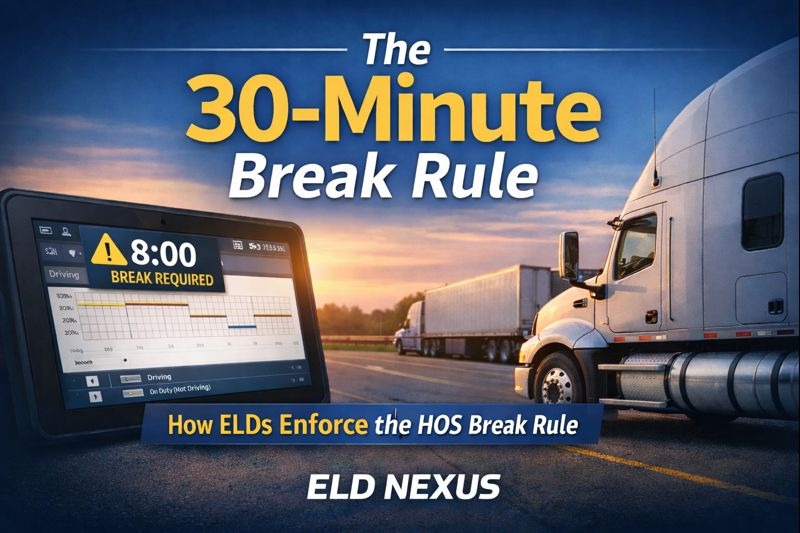
ELD systems enforce the rule through automated time tracking, not interpretation or discretion. A 30 minute break ELD system continuously calculates:
- Accumulated driving time
- Duty status changes
- Duration of non-driving periods
- Exact timestamps for all log events
Once a driver reaches 8 hours of cumulative driving time without a qualifying break, the ELD automatically records a violation. The system does not account for intent, operational context, or partial stops.
Which Duty Statuses Qualify as a Valid Break
For ELD enforcement purposes, the following duty statuses qualify when logged for 30 consecutive minutes:
- Off Duty
- Sleeper Berth
- On Duty (Not Driving)
A driver may use one status or a combination of these statuses, provided the total duration is uninterrupted and meets the 30-minute requirement.
Important Enforcement Detail
Any transition into Driving status, even briefly, resets the break timer and invalidates the break.
Common Reasons for 30-Minute Break Violations
Many violations occur due to misunderstanding how ELDs calculate time, rather than intentional non-compliance.
1. Break Taken Too Late
If the break begins after the 8 hour driving limit has already been reached, the ELD will still record a violation.
2. Incorrect Duty Status Selection
Activities such as fueling or inspections only qualify if logged as On Duty (Not Driving) for the full 30 minutes.
3. Interrupted Breaks
Multiple short stops or interrupted breaks do not satisfy the requirement. The rule requires 30 consecutive minutes.
Why the HOS Break Rule Feels “Stricter” Under ELDs
ELDs apply FMCSA regulations exactly as written, without flexibility. The software:
- Measures time to the minute
- Applies rule logic automatically
- Flags violations immediately
- Maintains a permanent, auditable log record
This precision often exposes compliance gaps that were previously overlooked under paper logs.
Compliance Best Practices for the 8 Hour Driving Limit
To remain compliant with the HOS break rule, fleets and drivers should:
- Plan breaks before reaching 7.5 hours of driving time
- Use qualifying duty statuses consistently
- Avoid duty status changes during breaks
- Review logs daily for accuracy
- Monitor remaining drive time proactively
The Role of ELD Nexus in Break Rule Compliance
ELD Nexus is a software-based ELD and compliance management solution.
It does not manufacture or provide ELD hardware.
The platform focuses on:
- Accurate log data handling
- Clear visibility into driving time accumulation
- Rule-based compliance awareness
- Clean, inspection-ready log presentation
By improving log clarity and enforcement transparency, ELD Nexus supports fleets in understanding and managing ELD-applied HOS rules, including the 30 minute break requirement.
Frequently Asked Questions (FAQs)
Does the 30-minute break have to be taken off duty?
No. FMCSA regulations allow the break to be logged as Off Duty, Sleeper Berth, or On Duty (Not Driving), provided it lasts 30 consecutive minutes.
Does the 30-minute break reset the 11-hour driving limit?
No. The break only satisfies the requirement related to the 8 hour driving limit. It does not reset the 11-hour driving cap.
Can fueling or loading count as a break?
Yes, but only if the activity is logged as On Duty (Not Driving) and continues uninterrupted for 30 minutes.
Why did my ELD show a violation even though I stopped?
Most violations occur due to incorrect duty status selection, insufficient duration, or starting the break after the 8-hour threshold was reached.
Is ELD Nexus a hardware ELD provider?
No. ELD Nexus provides software solutions only, focused on compliance visibility and ELD data management—not physical ELD devices.