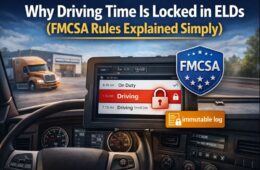
An ELD ( logging device) goes in your trucks engine and keeps track of how long you’re on the road. It’s the replacement for paper log books. Most commercial drivers in the U.S. who keep hours of service logs are required to use an ELD – unless your device isn’t registered on FMCSA’s list.
This last bit is more of a concern in 2026 than it has been in a long time. So, to the bottom line and the long.
The elevator pitch
What Is ELD?
ELD is the abbreviation for logging device. It allows the driver to track drive time and hours of service (HOS).
You need one if you file duty status (RODS) records under 49 CFR Part 395.
A time record is not required if you have paper logs for 8 days or less within any 30-day period, all of which meet the short-haul time-record exception for either driveaway-towaway work, or to drive a vehicle of a model-year engine.
The 2026 catch: FMCSA keeps delisting ELD models. If your continuing to use one you can be fined for no record of duty status and put OOS.
Verify your device on the FMCSA registered list. A sales page is not sufficient evidence.
How an ELD works
Think of it as a “black box” for your workday. It ties into the engine’s port so you can’t discreetly “miss” an hour behind the wheel like you could on paper.
Most systems consist of three components: The hardware installed on the truck, a driver app installed on a smartphone or tablet, and a back-office dashboard used by the carrier. The ELD provider is the business that makes the device, gets the device certified and registered with FMCSA. Keep that role in your head, as that’s where the risk lives.
So a typical shift is:
Log in with your account.
Select your status for -driving period: on-duty sleeper berth or off-duty.
Drive You are out of range of the marker and the ELD is in Auto Drive by itself once you have moved over 5 mph.
Stop. Asks after a minutes if you still are driving. No reply. Then drops to on-duty.
Certify your log every 24 hours. – Every edit requires an explanation in writing.
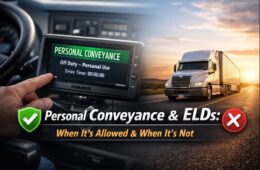
While you’re on the road, it records time (at 60 minute intervals and any change in your status, engine on/off), location, engine on/off, motion, miles, engine hours, driver ID, vehicle ID, carrier ID. Location is precise to within a mile on duty, and will default to approximately 10 miles during personal conveyance, to avoid tracking you on your day off.
Inspections data is sent to the officer via telematics (web services, e-mail) or local transfer (USB 2.0, Bluetooth).
Who needs one
Who operate commercial motor vehicles (CMVs) and are required to have RODS in interstate commerce and in most states intrastate as well. CMV means:
10,001 pounds or more (GVWR or GCWR)
Carries placarded hazardous materials
Is designed to carry more than 8 passengers including the driver (for hire).
Designed for more than 15 passengers (including the driver) for purposes other than carrying persons for hire or transport.
An owner-operator is not exempt, even if its only one truck.
Easiest exemptions: paper logs less than 8 days within any 30 day time frame, for driveaway-towaway, or engine manufactured prior to MY 2000, locate the engine label, not the trucks year.
Gray areas: drivers who only work short distances (140 air-miles and finished within 14 hours) can track time rather than using RODS. Many haulers in agri-transport enjoy the 150-air-mile hours-of-service exemption, which is determined by each state. Check with FMCSA or your state enforcement office if you’re not sure if you qualify.
History if you’re seeing marketing here ELD rule first published 10 December 2015 (compliance date for drivers) 18 December 2017; AOBRD’s (old models) discontinued 16 December 2019. An app that isn’t connected to the vehicle engine is not an ELD.
The HOS rules its watching
The ELD doesn’t set the rules. It turns the clock. For property-carrying drivers:
You are on the truck for 11 hours and you have had 10 hours break.
No drive after the 14th hour of being on duty
A 30-minute break after 8 hours of cumulative driving time
60/70 hours on duty in 7 or 8 days
A 34-hour restart to rectify the weekly clock
An ELD should notify you before a violation, not after. That beats “no paperwork” every time.
What compliance actually takes
Carriers must:
Use a registered ELD
Operate the trains and provide necessary in-cab documentation
Have a malfunction process
Save six months records
Repair or replace a broken ELD in 8 days
Never use ELD data to intimidate or coerce your drivers
Each driver is required to sign on a driver’s account every 24 hours and to identify or not identify an un-certified record of driving.
One 2026 update: final rule published on June 22, effective July 22, removes requirement to keep operator’s manual in truck. All the other items that you’ve been required to keep in the truck, including the data transfer instructions, the malfunction instructions and the blank paper log forms, remain.
The big 2026 story: revoked ELDs
FMCSA doesn’t verify the ELDs. Vendors self-certify and register their products. If an ELD is determined to not be compliant, FMCSA remoes it from the list and moves it to a revoked list.
It’s happening a lot. July’s law firm reporting reported 79 models taken off since January 2025 with HERO ELD in April ten models in July and five on August 6.
Every removal has a date, approximately 60 days. Following that, operating the device is considered no record of duty status, (See: 49 CFR 395.8(a)(1)). That’s an out-of-service and a mark on your CSA HOS score.
Expiring: for the five devices taken away on August 6 the deadline was October 6 2026. If you are still running one you are well past it.
Check your ELD in five minutes:
Locating your Devices ELD identifier and model.
Check it on the FMCSA ELD listing.
Make sure it’s registered and not revoked.
Get it in writing from your provider what occurs if it ever does.
Subscribe to FMCSA’s ELD email updates. Set a reminder to re-check every quarter.
If yours is revoked … Don’t be the bottleneck. Moving hardware across a fleet always seems to take longer than you expect.
What it costs
How much does it cost? FMCSAs own projections (from its oversight report published in April 2023) are approximately $419 per vehicle per year for ELDs and approximately $166 for Bluetooth or USB local-transfer ELDs. The actual costs are driven by hardware purchase (sales, leasing or packaging), per-vehicle subscription services, contract length, features offered like GPS or dashcam support and cancellation/installation fees.
Here are three prices. Request the total cost of ownership, per month, for 12 and 36 months. Here’s a cheap ELD that gets revoked versus a competitively priced ELD that remains active.