Managing a trucking fleet requires balancing numerous factors including delivery schedules, driver availability, road conditions, and customer expectations, not to mention safety. As your fleet grows, ensuring compliance with the Hours of Service (HOS) becomes increasingly difficult.
Drivers on your fleet are likely approaching a driving limit, an unassigned driving event may need review, or log discrepancies may go unnoticed until someone reviews the logs. Each of these increase your compliance risk.
Checking logs more frequently is not the best solution to address these compliance risks. Consistent processes for driver monitoring are needed to ensure alerts and issues are addressed.
In this guide, we will explain how your safety and operations teams can make immediate improvements to HOS compliance for your trucking fleet.
Why HOS Compliance Matters for Trucking Fleets
The goal of Hours of Service (HOS) regulations is to prevent driver fatigue by limiting the amount of time a driver can spend driving or be on duty and mandating rest. From a fleet safety management perspective, compliance is about accurate record keeping, as well as driver and overall safety and efficiency of the operation for HOS violation prevention.
Not properly managing HOS can cause:
- Drivers exceeding allowable on duty or driving limits.
- Incomplete or incorrectly recorded duty status.
- Miles of driving time that remain unassigned to a duty status and require investigation.
- Inconsistent communications between safety personnel and drivers.
- Repeated violations that could have been caught and addressed earlier.
- Disruption of effective dispatch and on-time delivery.
- Inconsistent ability of individuals to assess whether there has been a violation.
Taking a proactive for fleet compliance California approach to meeting Hours of Service requirements helps fleets see possible problems before they turn into a significant operational issue.
1. Understand the HOS Rules Your Drivers Follow
Make sure your team understands applicable rules before focusing on improving compliance.
For a property carrying driver subject to the standard federal rules, major limitations usually include the following:
| 11 hour driving limit:A driver may not drive more than 11 hours after 10 consecutive hours off duty. | 14 hour On Duty Limit:A driver may not drive beyond the 14th consecutive hour after coming on duty, following 10 consecutive hours off duty. |
| 30 minutes break:A driver is required to take a 30-minute break after 8 cumulative hours of driving. | 70 hour Weekly Cycle:A driver may not drive after accumulating 60 hours of on-duty time in a period of 7 consecutive days (7 days if the carrier operates daily) or after 70 hours in a period of 8 consecutive days. |
There are exceptions, varying interpretations, and other provisions. Carriers should ensure they understand which rules apply to their drivers and operations.
Drivers and dispatchers making decisions based on the understanding of these limits can improve trip planning, rest breaks, loading delays and scheduling.
2. Build a Daily HOS Compliance Workflow
Everyday compliance helps safety teams alleviate the need to rely on memory to conduct random checks.
Not every driver should be treated with the same level of scrutiny. Began with a risk review of the following at the beginning of every shift.
| Drivers approaching their driving or duty limits | Drivers with limited hours left | Possible violations in current or recent logs |
| Unassigned driving events | Missing information or records | Drivers in need of log corrections and follow up |
Risks should be identified prior to beginning work to help the safety teams make decisions and dispatches adjust or assign trips.
Follow up throughout the day
HOS monitoring should continue past the morning review. All of the factors that are outside of a driver’s control (i.e. driving schedules, traffic, weather, loading delays, unexpected stops, etc.) can quickly deplete the available hours for a driver.
- Open compliance issues
- Resolved issues
- Drivers contacted
- Pending corrections or documentation
- Repeat issues requiring coaching
A record should be kept of which drivers have been coached for recurring violations. This should facilitate the process for the next day’s review.
3. Use ELD Alerts to Identify Risk Early
Drivers can’t create and route ELD alerts to safety teams automatically. Safety teams have to check ELD alerts to identify potential compliance issues and take action.
Effective ELD alerts management involves more than just receiving notifications. It is important to determine the meaning and urgency of alerts and assign the appropriate response.
For example, a driver approaching his/her driving limit may require an immediate discussion with dispatch to let the driver know not to exceed the driving limit. An unassigned driving event may require reviewing the vehicle activity to determine who operated the vehicle.
- An effective process for alert management:
- Prioritizes alerts based on the urgency
- Assigns alerts to responsible team members
- Reviews records and takes appropriate action
- Contacts the driver to obtain clarification if needed
- Documents the action and outcome
- If issue is not resolved, informs management
Do not consider every notification as an urgent case. This gives the team an opportunity to focus on the important issues.
4. Train Drivers on Accurate Logs and Duty Statuses
Technology won’t replace driver knowledge. Drivers have to learn how to use their ELD correctly and understand the importance of documenting logs accurately.
Train drivers on HOS compliance during the onboarding process and repeat this training as needed if there is a recurring problem.
The training should include:
- Why it’s important for drivers to change their duty status correctly.
- Reviewing logs before submitting them.
- Responding to the notifications provided by the ELD.
- How to deal with unassigned driving events.
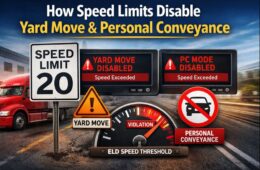
- Understanding personal conveyance and yard moves.
- How to report a malfunction to the ELD.
- Communicating schedule changes.
Keep training interactive and practical. Use situations that happen on a daily basis to illustrate common mistakes. For California trucking businesses, driver education is especially important when managing different routes, schedules, and applicable state or federal requirements.
5. Review Unassigned Driving Time
Unassigned driving events must be reviewed in a timely fashion to confirm who was driving, if driving event records need to be corrected, or if the MCS-150 needs to be changed. Fleet Managers must concludes:
- Review unassigned events daily.
- Confirm the correct driver
- Initiate the appropriate correction process.
- Correct documentation.
A consistent process supports California trucking compliance and trucking operations across other regions.
6. Use HOS Compliance Software
HOS compliance software provides fleet managers a better way to monitor their drivers’ logs, alerts and potential violations.
Valuable features may include:
- HOS monitoring
- ELD alerts
- Driver log review
- Unassigned driving reports
- Compliance tracking
Fleet managers can simplify their daily compliance management by utilizing an effective monitoring tool for ELD compliance California solutions or ELD compliance services in California.
7. Track Fleet Compliance Performance
Tracking compliance performance enables management to identify recurring issues and improve their fleet operations.
- Management should monitor:
- Open compliance issues
- Resolved violations
- Unassigned driving events
- Driver follow-ups
- Repeating errors
Tracking and evaluating these analytics assists in resolving fleet operations and compliance California issues.
8. Create a Repeatable Compliance Workflow
A simple workflow for daily HOS compliance includes:
Monitor → Review → Resolve → Document → Report
Managers running operations in LA, Sacramento, San Diego, and Fresno can use this same consistent workflow to maintain visibility and manage compliance to the California
HOS requirements.
Daily HOS Compliance Checklist
 Review driver HOS clocks
- Check ELD alerts
- Identify possible violations
- Review unassigned driving time
- Discuss violations with driver
- Take corrective action
- Prepare end of shift report
FAQs
1. What is HOS compliance?
Hours of Service compliance pertains to the regulation of the work and driving hours of a commercial driver.
2. How can fleets avoid HOS violations?
Fleets can avoid HOS violations by monitoring drivers’ hours, reviewing ELD alerts, and addressing them proactively.
3. What is HOS monitoring?
HOS monitoring is the process of capturing driver hours and statuses and potentially violating drivers.
4. What is the purpose of ELD compliance?
An ELD is mandatory in order to comply with the Hours of Service rules.
5. How frequently should logs be reviewed?
Frequent reviews (i.e. daily) help address and resolve issues quickly.
6. What is unassigned driving time?
This represents driving time that has been captured by the ELD and is not assigned to a driver.
7. Can HOS compliance be improved with software?
Automation of various compliance tasks helps improve HOS compliance.
8. What is a daily compliance workflow?
A workflow that is repeated daily for monitoring, resolving and documenting compliance issues.
9. Are there California trucking compliance requirements?
Yes. All trucking fleets are required to comply with applicable federal and state regulations pertaining to their operations.
10. How can driver safety compliance be improved?
By means of training, proactive monitoring and follow up.
Conclusion
Having a workflow that helps monitor drivers, use the system, and capture data helps meet HOS compliance needs. With the right process and HOS compliance software, trucking companies can reduce compliance risks and manage their day-to-day business activities. ELD Nexus understands the needs of the trucking industry. Contact ELD Nexus to simplify your fleet compliance workflow.